
Fundamental Seismogenic Faults of the Alborz
Project Leader: Dr. Mohammad Reza Ghassemi
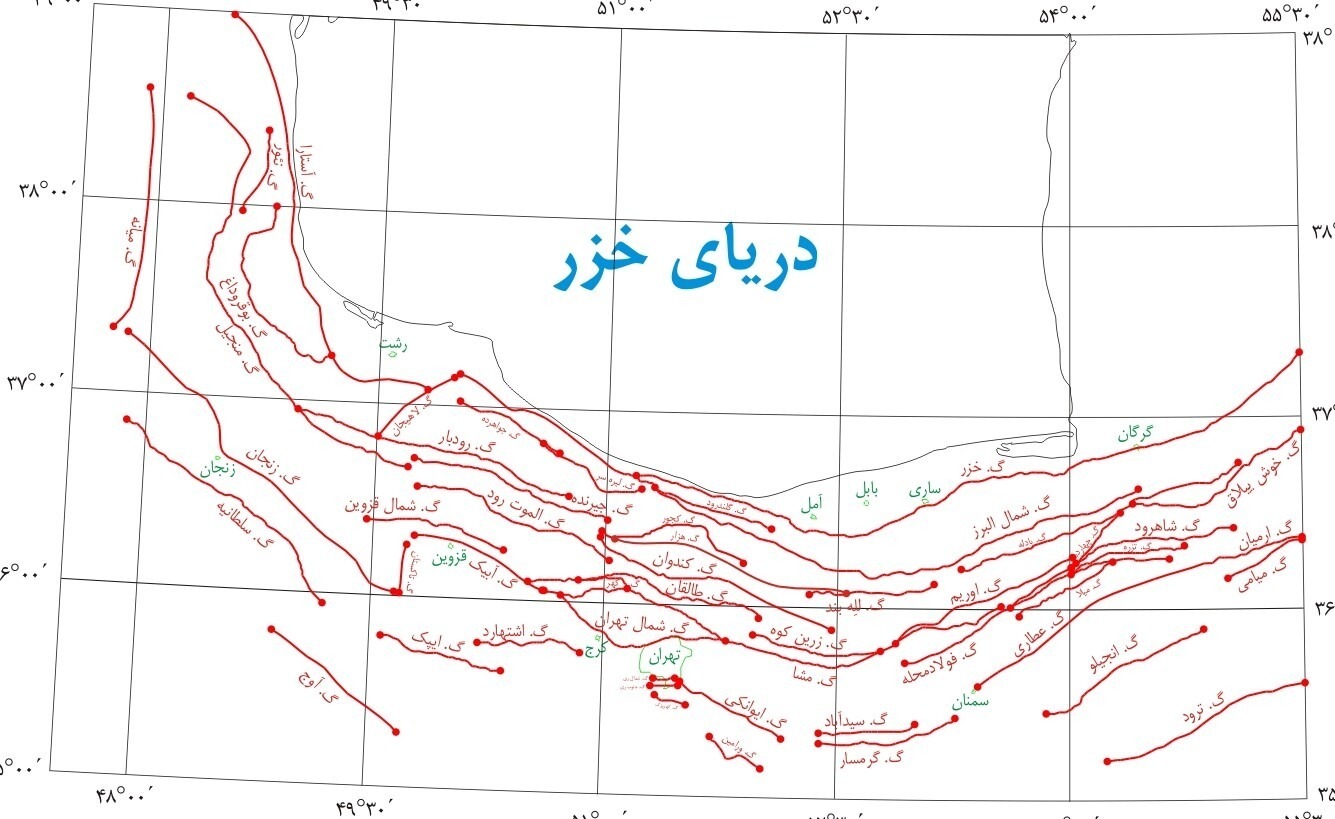
The densely populated Alborz mountain range in the north of the Iranian Plateau is considered one of the seismically active regions of the country due to its uplift and active lateral movements. This study aimed to accurately identify the fundamental seismogenic faults of the Alborz range and investigate them in terms of geometry, kinematics, and seismicity.
Geological maps at scales of 1:250,000 and 1:100,000 were used to investigate the geometry and kinematics of the faults. Efforts were also made to supplement these data using other available sources, including aerial photographs, satellite imagery, and published documents. A fault map was prepared at a scale of 1:2,500,000, and the characteristics of the faults were presented within the framework of the corresponding report and maps.
The principal outcome of this research project was the compilation of a comprehensive inventory of 51 major faults in the Alborz range. The total length of these faults is approximately 6,578.5 km, and, despite minor local variations, their orientations generally follow the overall trend of the Alborz arc. The present study indicates that the principal faulting mechanisms in the Alborz are thrusting and left-lateral strike-slip faulting, with strain partitioning occurring through the spatial and temporal partitioning of movement along these faults.
Approximately 63% of the total length of the major Alborz faults is represented by thrust faults, while about 37% consists of strike-slip faults with a reverse component. Among the thrust faults, the ratio of faults dipping toward the Caspian Sea (north and east) to those dipping away from the Caspian Sea (south and west) is close to one. In contrast, the generally steeply dipping strike-slip faults predominantly dip northward rather than southward.
The major faults on the northern slopes of the Alborz generally dip away from the Caspian Sea, whereas the major faults on its southern slopes predominantly dip toward the Caspian Sea. The strike-slip faults of the Alborz are mainly concentrated in its southern half and along its boundary with Central Iran. The strike-slip component of these faults is consistently left-lateral throughout the Alborz. A minor component of normal displacement is observed along some of the strike-slip faults in the region.
Nearly all of the 51 faults identified in this study are seismically active. Many of them coincide with the seismic gaps of one or more historical or contemporary earthquakes or with the epicenters of instrumental earthquakes.
Among these, the faults of greatest significance in terms of seismic hazard in the Alborz region include the North Alborz Fault, Caspian Fault, Mosha Fault, Rudbar Fault, Manjil Fault, Jirandeh Fault, Meyaneh Fault, Alamut–Rud Fault, Taleghan Fault, North Qazvin Fault, Ipak Fault, Fouladmahaleh Fault, Badaleh Fault, Khosh-Yeylaq Fault, Laleh-Band Fault, Shahroud Fault, Damghan Fault, Torud Fault, Garmsar Fault, Eyvanekey Fault, and North Tehran Fault.
Sending comments for this product is not allowed.