Applied Stratigraphy and Sedimentology Research Group
Related Professors: Dr. Razieh Lak - Dr. Mahmoud Reza Majidi Fard
 Introduction
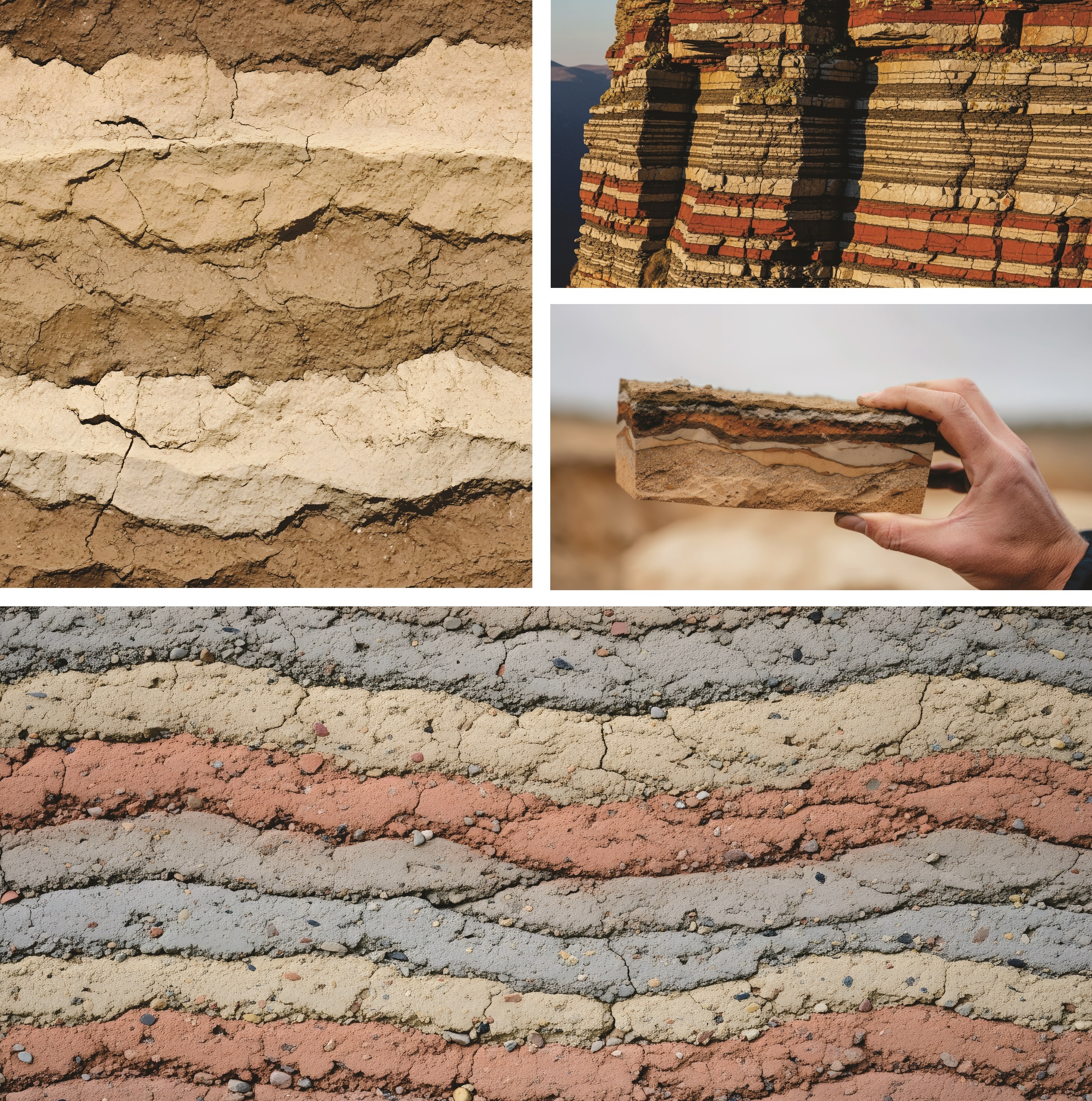
Stratilogy and Applied Sedimentology is a key and parent branch of Earth Sciences that studies the layering (strata), formation processes, properties, and succession of sedimentary rocks. The focus of this group is on understanding past and present sedimentary systems in order to answer practical questions in the fields of oil and gas exploration, understanding groundwater resources, prospecting for layered mineral deposits (such as coal, phosphate, some iron ore deposits), geotechnical engineering, and reconstructing climate and environmental changes in the Earth's past. This knowledge opens a window into Earth's history by analyzing facies, paleomorphology, and relationships between layers and provides a scientific basis for many exploration and development activities.
The Stratigraphy and Sedimentology Research Group conducts basic studies in Iranian geology, and its goal is to identify the Iranian crust, its constituent materials, and the physical, chemical, and biological processes that act on it. The main research areas in this research group are:
Stratigraphy: This branch of fundamental geology studies the characteristics of rock strata. During these studies, the sequence of rock sets, age relationships of rock strata, shape, distribution, rock composition, and their fossil content are examined. Stratigraphy has two main sub-branches: rock stratigraphy and biostratigraphy.
Paleontology: These studies examine the traces and remains of past organisms and, based on them, determine the relative age of the Earth's layers and the habitat of ancient organisms. Paleontology is divided into two main branches: macrofossils and microfossils.
Sedimentology: Materials resulting from mountain erosion by water, wind, and ice are transported to lowlands or sedimentary basins and accumulated there. The pressure resulting from the weight of sedimentary layers gradually transforms these deposits into sedimentary rocks. In sedimentology and sedimentary lithology studies, the processes of transport, deposition, and transformation of sediments into sedimentary rocks, as well as the formation of ancient and modern sedimentary basins in different regions of Iran, are investigated.
Preparation of regional and thematic geological maps: The purpose of these studies is to depict various features of fundamental geological studies in the form of maps with different scales from different regions of Iran. These activities can include the preparation or revision of conventional geological maps at scales of 1/250,000, 1/100,000, 1/50,000, and 1/25,000, or they can be carried out in the form of regional surveys to examine sedimentary, stratigraphic, or tectonic features.
Tasks and Objectives of the Applied Stratigraphy and Sedimentology Research Group
- Facies and Sedimentary System Analysis: Identification and interpretation of ancient sedimentary environments (e.g. fluvial, deltaic, shallow marine, deep marine, aeolian) based on lithological features, sedimentary structures, and characteristic fossils.
- Sequence Stratigraphy: Analysis of sedimentary sequences using sequence stratigraphy to identify prograding and retrograding marine cycles, which is a key map in oil exploration (determination of reservoir, cap, and source rocks) and identification of important aquifers.
- Petroleum and Reservoir Geology: Study of microfacies (microfacies) and diagenetic characteristics of carbonate and clastic rocks in order to assess the quality and behavior of hydrocarbon reservoirs.
- Sedimentology and economic geochemistry: The study of layered and placer deposits such as banded iron, phosphorite, manganese, bauxite, and gold-bearing placers for exploration purposes.
- Paleontology and biostratigraphy: The use of fossils (macro and micro) to determine the relative age of rocks (biostratigraphic zoning), reconstruct ancient environments, and determine extinctions and major geological events.
- Isotopic and geochemical stratigraphy: The use of stable isotopes (such as strontium, carbon, oxygen) and trace elements to determine precise absolute ages, determine the origin of sediments, and reconstruct past ocean temperatures and conditions.
- Coastal and fluvial sedimentology and geomorphology: The study of the dynamics and morphogenesis of present-day sedimentary environments for managing beaches and rivers, predicting erosion and deposition, and implementing development projects.
- Geotechnical and Sedimentary Rock Engineering: Evaluation of engineering properties of sedimentary rocks such as porosity, permeability, strength, and collapse potential for dam, tunnel, foundation, and mining projects.
- Reservoir Estimation and Modeling: Use of geostatistical methods and 3D modeling to estimate the volume and distribution of hydrocarbon reservoirs, coal seams, or other layered deposits.
- Development of New Analysis Methods: Use of techniques such as high-resolution isotopic analysis, digital image processing, numerical modeling of sedimentary systems, and remote sensing for advanced studies.
- Empowering researchers and students: to conduct detailed field studies, stratigraphic sections, systematic sampling, and interpretation of drilling and geophysical data within the framework of stratigraphy and sedimentology.
With an inextricable link between field observations, advanced laboratory analyses, and computer modeling, this research group serves as the backbone of exploratory and environmental studies in many national and international projects.