
Electrical Resistivity and Induced Polarization (IP) Investigations for Evaluating Lead–Zinc Mineralization Potential in the Tabas Region, Iran
Project Leader: Dr. Mehdi Mohammadi Vizheh
Client: Ahang Tejarat Nikoo Co.
Year: 2024
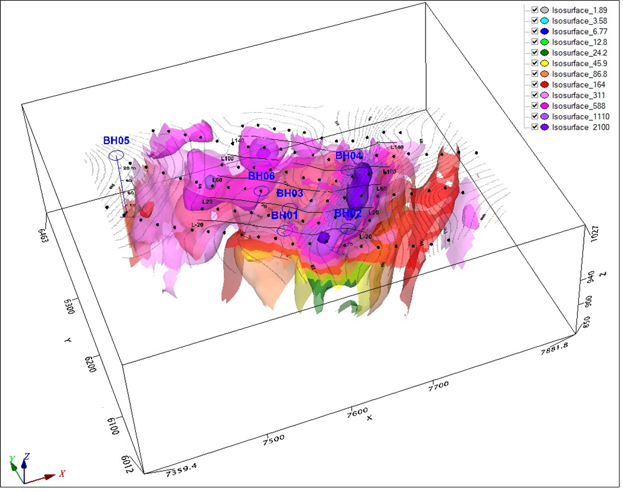
The two-dimensional and three-dimensional inversion models derived from induced polarization (IP) data in the study area reveal anomalies characterized by relatively high chargeability values (greater than 9 mV/V). Significant variations observed in the two- and three-dimensional resistivity inversion models are mainly associated with the presence of sedimentary units with contrasting electrical resistivity values. For instance, low-resistivity units such as shales and marls, and high-resistivity units including limestones, conglomerates, and metamorphosed sandstones, can be distinguished within the study area.
In the inversion models of Target Area 1, the metamorphosed sandstones and conglomerates appear to have been thrust over shale units as a result of reverse faulting. Several small-scale high-chargeability anomalies are identified within the shale and conglomeratic units. To investigate the depth extent and nature of these anomalies, several shallow exploratory drill holes have been proposed. The chargeability anomaly appears to extend toward the northern part of Target Area 1. In addition, considering the low resistivity of the shale unit and field evidence indicating the presence of silica veins, an exploratory borehole has also been proposed to investigate this zone at depth.
Interpretation of the resistivity models in Target Area 2 indicates that resistivity values decrease from the surface toward depth. This decrease is interpreted to be related to the presence of marl (or shale) units at depth. Most shallow chargeability anomalies coincide with relatively high-resistivity zones, which may be attributed to the hosting of potential mineralization within limestone units in this area. Deeper chargeability anomalies are associated with moderate- to low-resistivity zones. This pattern may result from either increased clay mineral content (due to the presence of marl and shale units) or higher sulfide concentrations at depth.
Considering the presence of numerous faults, particularly thrust faults, within the area, the occurrence of shale units beneath limestone formations is considered highly plausible. Based on surface geological evidence and confirmation of mineralization within carbonate units, the high-chargeability zones are interpreted as being potentially associated with sulfide mineralization, particularly pyrite-bearing mineralization. However, due to the presence of clay minerals within the sedimentary units of the area, the possibility of membrane polarization effects contributing to the observed chargeability response cannot be excluded.
Finally, to investigate the geoelectrical anomalies and evaluate the potential occurrence of concealed sulfide mineralization at depth, a total of 22 exploratory drill holes, with a cumulative drilling length of 1,935 m, have been proposed at this stage of the exploration program.
Sending comments for this product is not allowed.