
Magnetic Survey Investigation for the Exploration of Iron Mineralization in the Narigan–Bafq Region, Iran
Project Leader: Dr. Mehdi Mohammadi Vizheh
Client: Arya Kansar Karmania Co.
Year: 2024
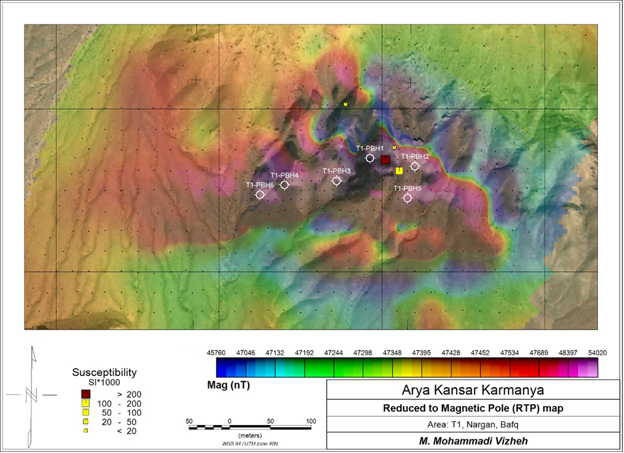
During this stage of the geophysical exploration program, the exploration targets within the Narigan area, including three prospects (T1, T3, and T4), were investigated using magnetic surveys. Significant variations in the magnetic field intensity, exceeding 8,000 gamma (nT), were detected in all three target areas.
Low magnetic intensity zones were mainly interpreted as being associated with carbonate units (within the T1 and T3 prospects), sedimentary deposits, and/or igneous rocks with lower magnetic properties, such as rhyolites and granites. Magnetic susceptibility measurements of collected rock samples confirmed this lithological variation. In particular, within the T4 prospect, the magnetic susceptibility of igneous units was measured at approximately 0.15 SI units. In this area, magnetite occurs disseminated within the igneous rocks, predominantly in a non-economic form.
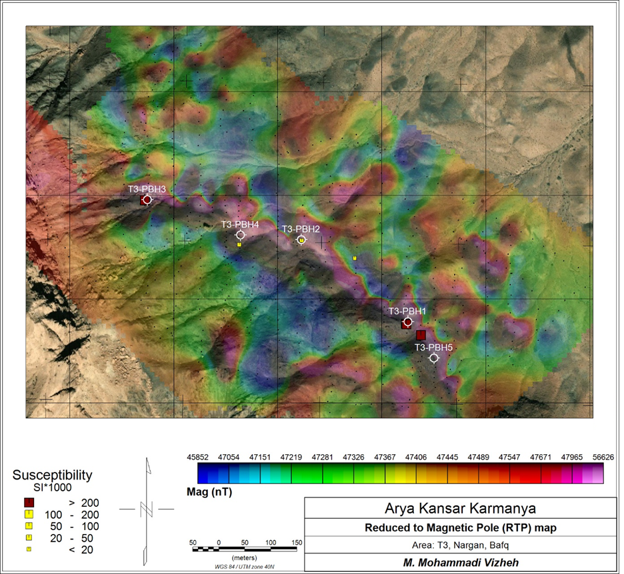
For geophysical resource estimation in the T1 and T3 prospects, the initial assumption was the presence of magnetite mineralization within these areas, which was incorporated into the magnetic data inversion process. In both prospects, the observed magnetic anomalies are interpreted to be controlled by faults within the igneous units or to have developed along the contacts between igneous and carbonate formations. In the T3 prospect, subsequent tectonic activity appears to have caused displacement of the potential magnetite body along fault structures. This structural complexity was considered during the inversion process by incorporating separate geological blocks for geophysical resource estimation.
Information regarding the remanent magnetization of the rock units was not available and therefore was not included in the geophysical resource estimation. Consequently, due to model simplification and the lack of complementary geological constraints, the estimated geophysical resources may contain considerable uncertainty. A reliable mineral resource estimation should be conducted only after confirming the presence and continuity of mineralization through the proposed exploratory drilling program.
Sending comments for this product is not allowed.