
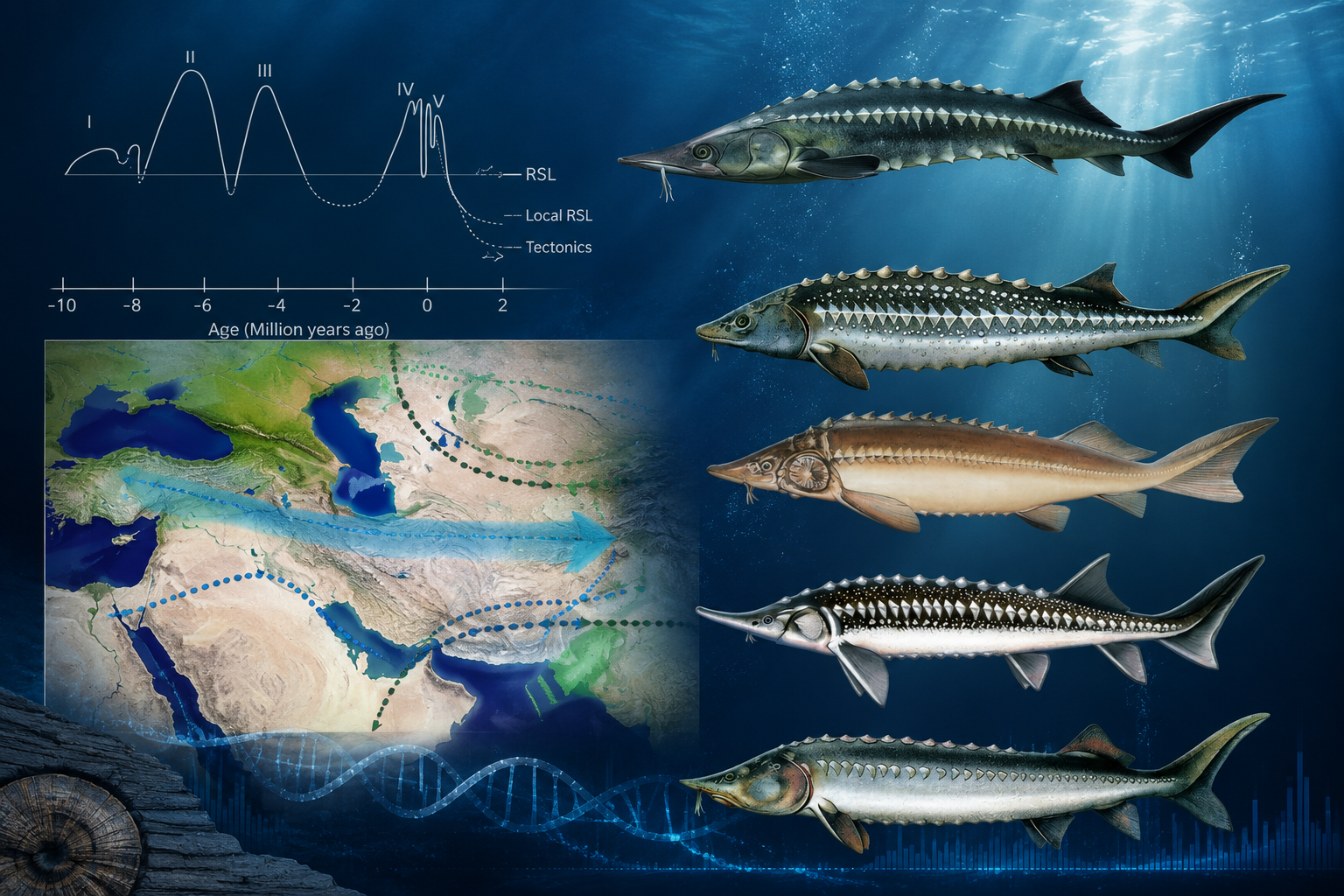
Research on the Species Diversity, Environmental and Climate Challenges, and Opportunities of Caspian Sea Sturgeons
Excutor of project: Dr. Alireza Va'ezi
Year: 2021
Client: Geological and Mineral Exploration Organization of the country
This study sought to examine the general characteristics of the Caspian Sea, the features of its coastlines with particular emphasis on the Iranian coast, their economic significance, and the major threats facing the Caspian ecosystem through a comprehensive review of reliable literature, scientific publications, and technical reports. The study also provides an overview of the Caspian Sea's flora and fauna, the diversity of sturgeon species, caviar production, and the factors responsible for the decline of caviar resources in the Caspian Sea.
Given the significance of climate change impacts on sturgeon stocks and related fisheries, the study further investigated future precipitation trends across the Volga River Basin and other parts of the Caspian drainage basin, including the Caucasus, Alborz, and Zagros regions, as well as the impacts of climate change on the Caspian Sea and its sturgeon populations. To this end, a comprehensive assessment of the impacts of climate change on the vulnerability and adaptive capacity of Caspian sturgeon species was developed based on literature review and expert opinions. A researcher-designed questionnaire was prepared and distributed among an expert panel comprising 21 specialists in fisheries, sturgeon biology, and climate change.
A review of credible scientific studies identified two major hypotheses regarding future climate changes within the Caspian Sea watershed. The first hypothesis suggests a decline in the Caspian Sea water level. The second hypothesis, which forms the basis of this study, proposes that continued global warming will strengthen the South Asian monsoon system over southern Iran. Based on well-established paleoclimatic evidence, this strengthening is expected to shift the mid-latitude westerly circulation northward, resulting in increased precipitation over the Volga River Basin—the primary source of inflow to the Caspian Sea—and consequently leading to a rise in the Caspian Sea water level. Furthermore, the observed relationship between Caspian Sea level fluctuations and solar activity also supports the likelihood of future sea-level rise. In other words, the majority of the Caspian drainage basin lies within the European territory of Russia, where climate projections indicate increases in both air temperature and precipitation. Although projections for precipitation over the Volga Basin and the other parts of the Caspian watershed (the Caucasus, Alborz, and Zagros regions) exhibit two contrasting trends, the expected increase in precipitation over the Volga Basin is likely to enhance Volga River discharge into the Caspian Sea, ultimately resulting in a higher Caspian Sea level despite projected decreases in precipitation elsewhere.
The results indicate that rising sea levels and reduced salinity could have positive effects on the recovery of natural sturgeon stocks and improve the efficiency of sturgeon breeding and aquaculture. Increasing temperatures are also expected to benefit sturgeon farming by extending the duration of suitable thermal conditions for growth and feeding, while having little direct impact on wild stocks. Conversely, reduced precipitation in other parts of the Caspian watershed is expected to decrease river discharge, significantly reducing natural stocks and lowering the efficiency of sturgeon reproduction and aquaculture. In addition, increasing water acidity, more frequent phytoplankton blooms, and substantial changes in marine circulation patterns are anticipated to have adverse effects on these valuable fish resources. It should also be noted that water pollution, harmful algal blooms, the introduction of invasive species, and numerous other environmental changes may further intensify the detrimental impacts of climate change.
To enhance adaptation to the impacts of climate change, the management and implementation measures proposed in this study can help mitigate adverse effects while promoting the conservation and sustainable utilization of the valuable sturgeon resources of the Caspian Sea.
Sending comments for this product is not allowed.