

Reconstruction of Late Holocene Climate and Environmental Changes in South-Central Iran over the Past Three Thousand Years Using Multiple Sedimentological, Geochemical, and Biological Proxies from a Sediment Core Obtained from a Peatland in Southern Rayen
Excutor of project: Dr. Alireza Vaezi
Year: 2024–2025
Client: Geological and Mineral Exploration Organization of the country
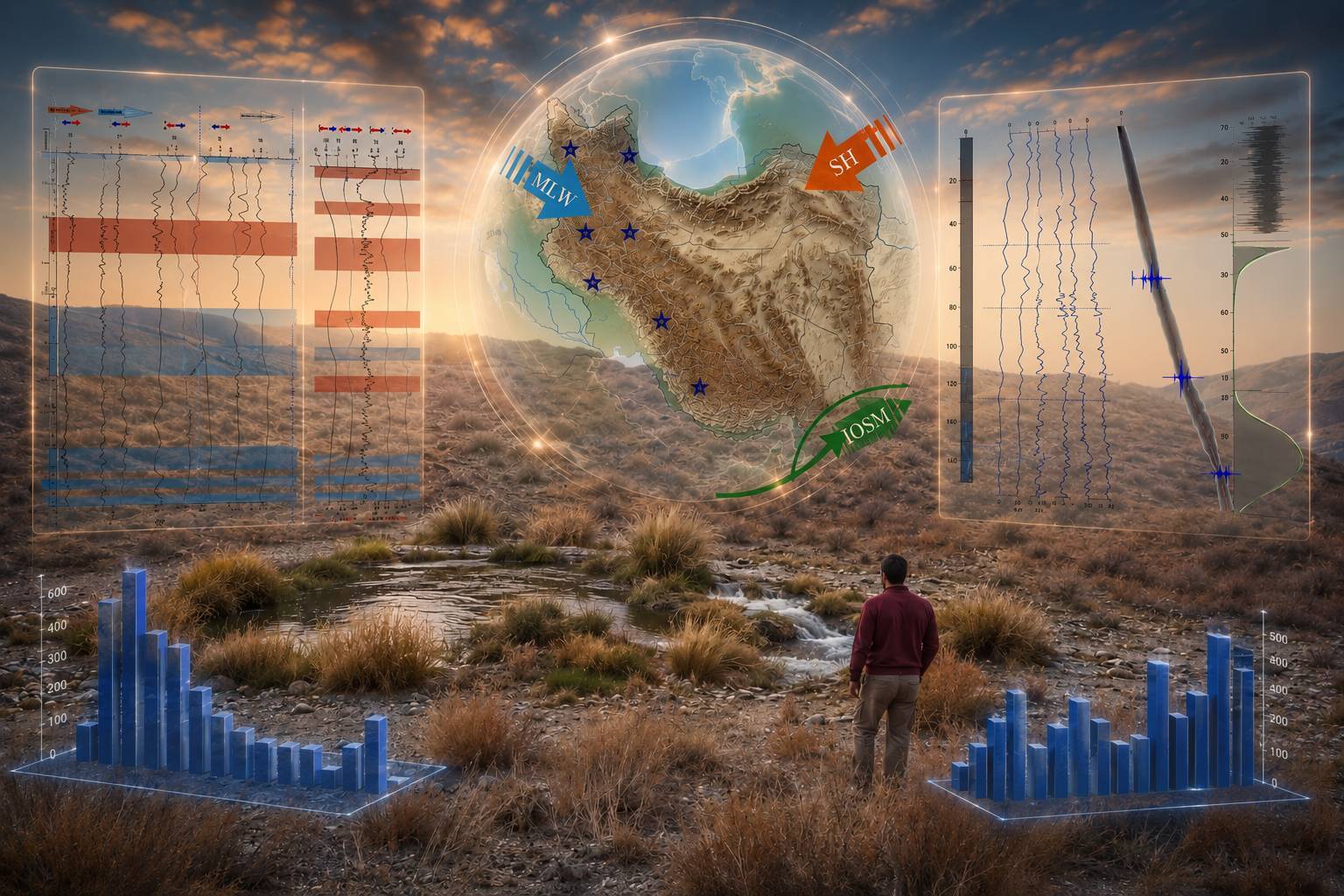
The present study aims to reconstruct late Holocene climatic and environmental changes in south-central Iran over the past 2,600 years by investigating multiple sedimentological (magnetic susceptibility and grain-size analysis), geochemical (chronological dating, elemental analysis, total organic carbon and nitrogen contents, and stable carbon isotopes of organic matter), and biomarker (biological indicators) proxies from a 1.6-meter-long sediment core recovered from a peatland located south of Rayen, within the Jebal Barez Mountains at the northwestern end of the Jazmurian Basin watershed.
Between approximately 2,575–2,500 and 2,400–2,200 years before present (BP), during the reigns of the Median and Achaemenid Empires, the studied region experienced relatively humid conditions. The wettest phase within this interval occurred around 2,300 years BP. These two humid periods were interrupted by a century of drier climatic conditions and relatively intense aeolian activity between 2,500 and 2,400 years BP.
From 2,200 to 1,550 years BP, a significant shift toward semi-arid climatic conditions occurred. Between approximately 1,550 and 1,200 years BP, a distinct transition toward wetter climatic conditions took place, characterized by reduced aeolian activity, waterlogged conditions, and the presence of aquatic plants within the peatland. These wetter conditions are supported by relatively low Ti/Al and Fe/Al ratios, a moderate C/N ratio of around 10, and decreases in ACL and TAR values.
From 1,150 to 625 years BP, the region experienced a semi-arid climate, coinciding with the Medieval Warm Period (MWP). This climatic shift resulted in increased aridity and enhanced aeolian activity, as indicated by higher Ti/Al and Fe/Al ratios and lower δ¹³COM_{OM}OM values. However, unlike earlier warm periods such as the Bølling–Allerød and the Early Holocene, the MWP did not provide sufficient warming to cause a significant impact on precipitation patterns within the Jazmurian Basin watershed.
From 625 to 300 years BP, corresponding with the Little Ice Age (LIA), the studied region experienced extremely dry and dusty conditions, evidenced by a significant increase in Ti/Al and Fe/Al ratios and the lowest values of δ¹³COM_{OM}OM and Paq. Subsequently, from approximately 300 years BP onward, semi-humid conditions were established in the region.
Sending comments for this product is not allowed.