
Assessment of the Magnetotelluric (MT) Method for Deep Exploration Based on Regional Profile Modeling in Kerman Province, Iran
Project Leader: Dr. Mehdi Mohammadi Vizheh
Year: 2025
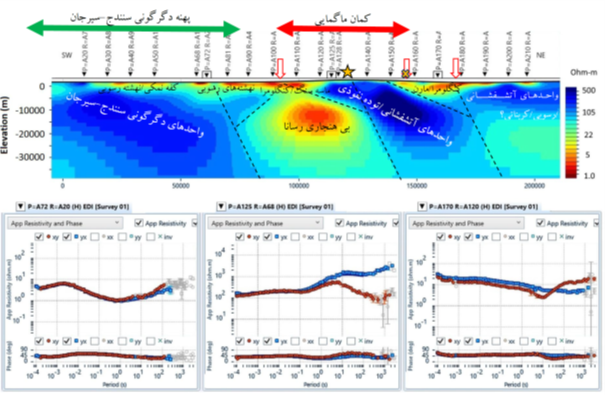
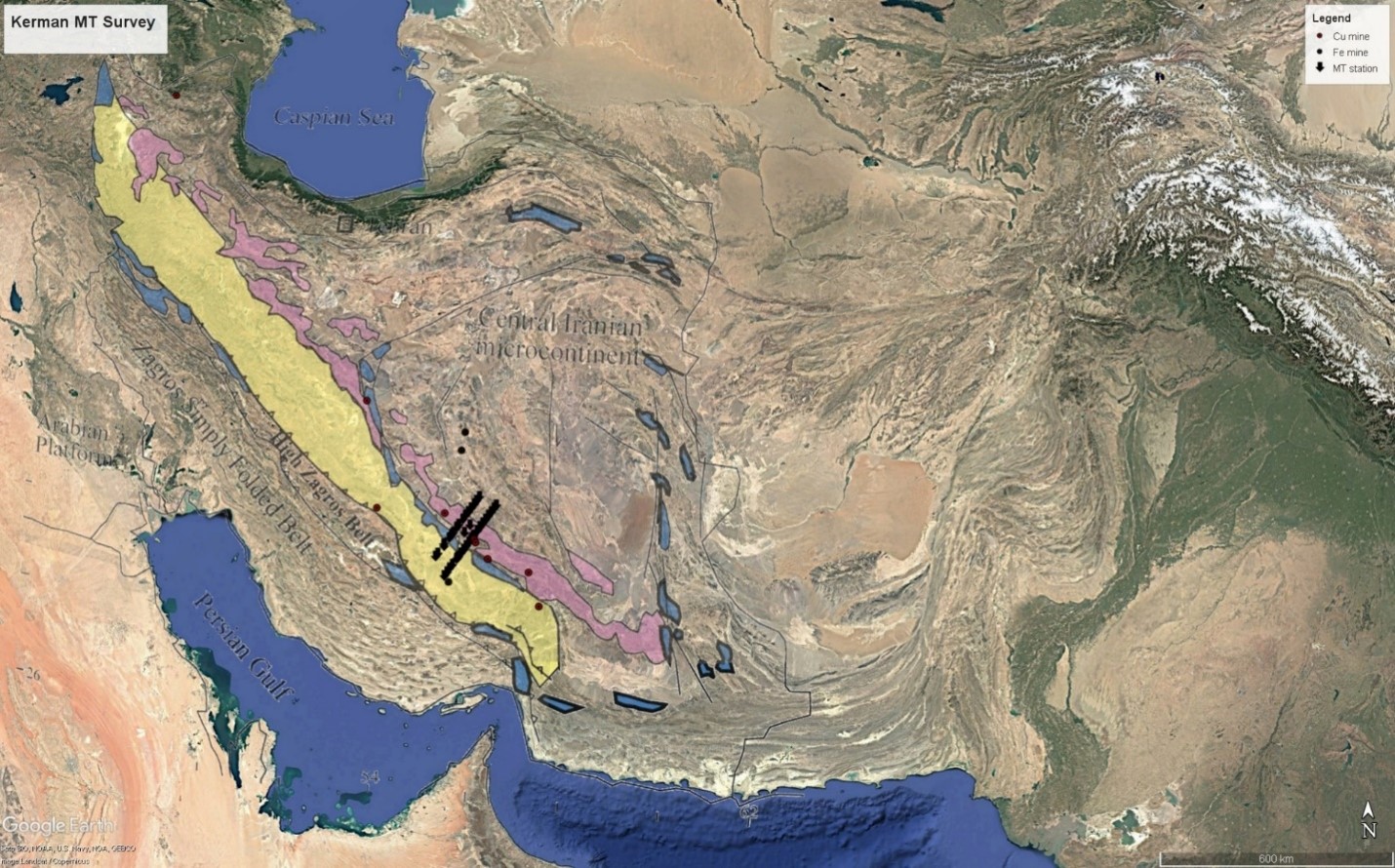
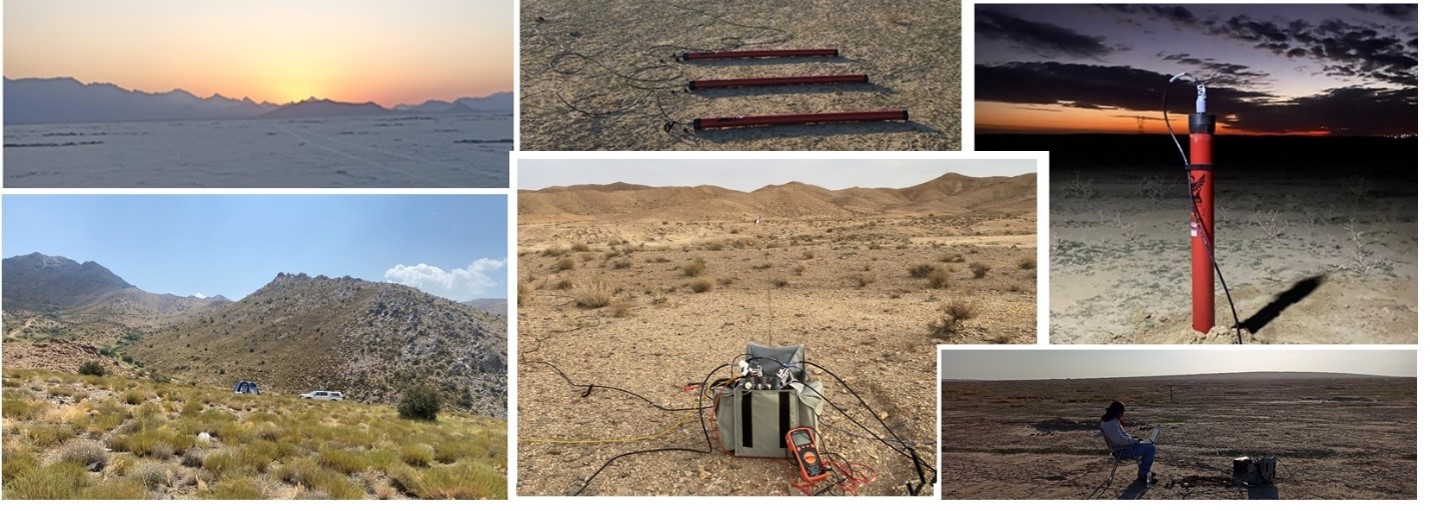
To enhance the understanding of geodynamic evolution, structural frameworks, and geological architecture within the Urumieh–Dokhtar magmatic arc and the Sanandaj–Sirjan metamorphic zone, a regional magnetotelluric (MT) investigation was conducted across the Dehaj–Sarduiyeh subzone. This area encompasses the Sarcheshmeh porphyry Cu deposit and several Manto-type mineral occurrences. 40 MT stations (including 38 along two survey lines, Profiles A and B) were collected to resolve the subsurface structure from near-surface layers down to depths exceeding 40 km.
Following data processing and quality control, dimensionality analyses and strike determinations were carried out to extract TE- and TM-mode data. Two-dimensional inversions of the profiles were then performed, and the resulting resistivity models were interpreted together with regional geological maps, exploration data, and aeromagnetic results.
The resistivity distribution in the inverted models can be effectively correlated with major lithological domains within the crust and upper mantle. Distinct signatures associated with the Sanandaj–Sirjan metamorphic belt, possible ophiolitic remnants beneath sedimentary cover, igneous complexes of the Dehaj–Sarduiyeh subzone, and main faults were delineated. A northeastward dip is observed in crustal units, induced by compressional stresses within the collisional regime.
A prominent low-resistivity anomaly (1–5 Ω·m) appears in the lower crust at a depth of approximately 10–20 km, spatially coincident with the Sarcheshmeh and Darrehzar copper deposits. The anomaly lies between the Shahre‑Babak thrust fault and the Sarcheshmeh intrusion and is masked by volcanic arc sequences, conglomeratic/sandstone rocks, and alluvial-fan deposits. Its conductive nature most likely reflects physicochemical interactions driven by magmatic and hydrothermal processes in the lower crust. It is therefore plausible that Sarcheshmeh, Darrehzar, and nearby Cu mineralizations originated from the ascent of ore-bearing fluids associated with deep-seated magmatic intrusions.
These results highlight a promising sector within the Kerman porphyry belt as a target for more detailed (local‑scale) MT and geological investigations aimed at resolving the geometry of the conductive source zone and clarifying remaining tectonic and metallogenic ambiguities.
Overall, this study demonstrates that MT data are highly effective for deliniate crustal domains and mapping deep tectonic architecture. Conductive anomalies within the lower crust and upper mantle provide distinctive exploration footprints for magmatic–hydrothermal mineral systems, consistent with the fundamental role of these deep regions as the source of large-scale ore-forming processes.
Sending comments for this product is not allowed.