
Fold Geometry and Strain Analysis of the Golpayegan Metamorphic Complex in the Jelmajerd Area
Excutor of project: Dr. Mohammad Reza Sheikholeslami
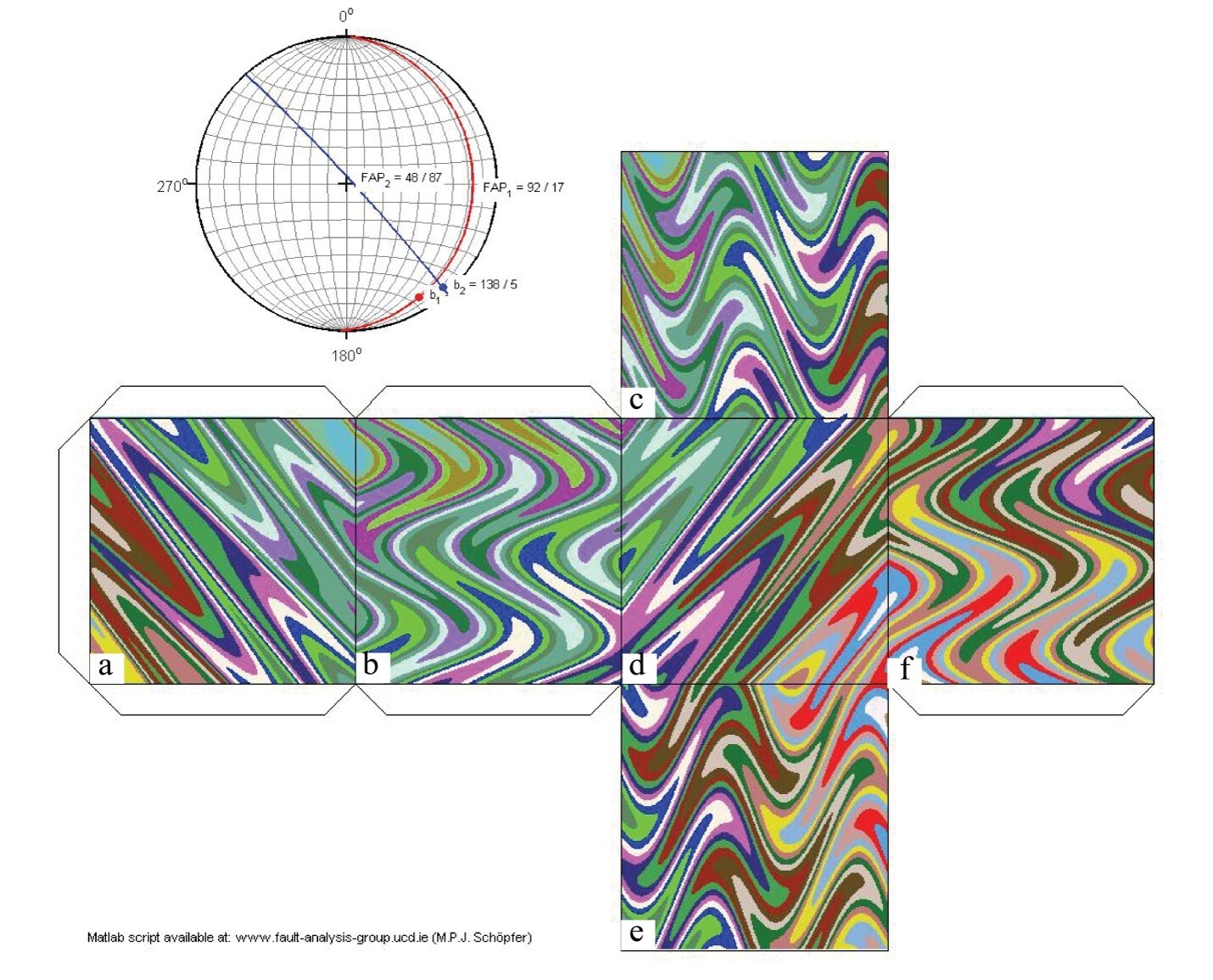
Modeling of geological structures plays an important role in understanding the geometry of the structures and their relationships. In recent years, digital modeling using computers has attracted the attention of engineers as well as researchers in basic sciences. "MATLAB" is one of the software that is used with its extensive facilities for data analysis and modeling in various sciences, including structural geology. In this paper, possible models of interference patterns of the three generations folds in metamorphic rocks of the Golpayegan area have been reconstructed using the script written in MATLAB software. The required data include the attitudes of the mean axis and the mean axial planes of three consecutive generations of folds which obtained during field measurements. Field studies show that the first- and second-generation folds are almost coaxial, however the third-generation folds have a different axial trend. The results of modeling indicate four classical fold interference patterns may form in horizontal (map view) and vertical sections in Golpayegan metamorphic rocks. Modeled fold interference patterns are closely consistent with the natural fold interference patterns observed in outcrop and regional scales. Using the modeling, it can be determined the different interference patterns of the folds in the northern Golpayegan metamorphic rocks are related to superposition of which fold generations.
Due to the formation of the boudins during two stages of the progressive deformation (D1 and D4) in cherty marbles, from north Golpaygan metamorphic complex, they have been analyzed for strain in two-dimension. This analysis is based on estimating of the initial length of the boudins before deformation, and measuring the current length of the boudins, after deformation. Calculation of the longitudinal parameters of the strain and drawing Mohr circles show that the strain ratio varies between 1.06 to 2.35 for D1 stage, and between 1.10 to 2.84 for D4 stage. The mean shear angle for the D1 stage is 22 ° and for the D4 stage is 24 °.
Sending comments for this product is not allowed.